Showing posts with label Y5-5. Show all posts

Friday, November 13, 2015

Week of 11/9/2015

Grades 3-5:  Fitness testing has begun!  This week, students in grades 3-5 started fitness testing items.  This week, most classes finished flexed arm hang and sit and reach testing.  For these two tests, we run the class in centers.  One center is the fitness test for that day.   Next week, we will do curl-ups and trunk lift testing.  For more information about fitness testing, see previous fitness testing blog posts (tagged with "Fitness Testing" in labels) or the FitnessGram website.

Upper elementary centers included:
  • exercises:  choose from ski jumps, jumping jacks, ABC strong soldiers, push ups
  • fitness test:  sit and reach or flexed arm hang
  • jump rope
  • hula hoops
Grades Y5-2:  Centers, centers, centers!  This week, younger students have learned and/or reviewed center expectations in PE.  These include:
  • follow the directions at the center
  • when music stops / whistle, clean up, sit, and point at your next center
  • stay at your center until the signal to clean up, sit, and point
Second graders also took a district common assessment.  The assessment is a written true/false test to measure cognitive concepts related to physical education and health concepts.
Lower elementary centers included:
  • exercises:  jumping jacks, ski jumps, ABC strong soldiers, scissor jumps, leg stretch, arm stretch
  • bowling
  • balance beam/sight word walk:  criss cross walk (crossing the body's midline) while reading sight words on floor tape
  • hula hoop
Criss cross sight words station.  Each piece of white tape has a sight word on it for students to read as they criss-cross step.  
Young Fives enjoy hula hoops!
Young Fives at our bowling center.
Our SXI class had centers, too:  bowling and tball!  Students loved using the ramp to roll the ball and knocking down the pins.  Tball is also fun, practicing holding the bat, striking the ball, and then zooming to each base.  

ASD classrooms continue with our routines each PE class:  walk, warm-up, skills, kickball, and choice time.  Warm-up time is focused on four main locomotor skills:  skip, gallop, sideways slide-step, and running.  These locomotor skills are the basis for most games and sports.  Skill work with each student depends on their current skill level, and is mostly focused on throwing, kicking, and catching.  These skills are the base for most games and sports.  

Health (1st grade) classes have worked on "Safety on Wheels":  bike, scooter, rollerblade, skateboard safety.  We looked at posters and discussed rules we should follow when using bikes, scooters, and other things with wheels.  Then, students drew a picture of themselves following safety rules using equipment with wheels.  During the second health class of the week, we started discussing fire safety!  We watched a 10 minute video about fire safety, and then discussed fire and burn safety rules.  

One student's drawing of her following bike safety rules
Safety on wheels illustration

First graders hard at work.
Skateboard safety

Skateboard and bike safety


Friday, October 30, 2015

Week of 10/26: Bowling, Bowling, Bowling

Our last week of bowling was this week.  Activities have included:
  • Fitness bowling:  Students rotate through the jobs on their lane, and then choose and complete an exercise before they bowl.  Students can choose a different exercise each time, or a different one - it's entirely up to each individual.  

Lower Elementary Fitness Bowling

Upper Elementary Fitness Bowling
Fifth graders.  Fitness bowling jumping jacks.  
Third and fourth graders:  Fitness bowling.  
    • BINGO bowling:  Students take turns bowling, trying to earn a BINGO.  The number of pins they knock down is the number they can mark on their BINGO scorecard.  We note lanes in order of their Bingos on the dry erase board!  

      Bingo Bowling Scorecard.  This is Lane 2's card.  Each lane works together to earn a BINGO!  

    Have a safe, happy, and healthy long weekend!

    Monday, October 19, 2015

    Week of 10/19/2015 and 10/26/2015: Bowling, Bowling, Bowling!

    Haisley is fortunate to participate in a program called In-School Bowling (Bowler's Ed), in partnership with Bel-Mark Lanes.  Bel-Mark provides 6 carpet bowling lanes, 6 sets of pins, and 6 bowling balls (rubber) for two weeks.  They deliver and pickup the lanes, and students enjoy them in the meantime.  This morning, students were SO EXCITED as they entered the gym to see the bowling equipment set up!  (Thanks to my morning and afternoon helpers for the setup assistance!!)


    For older students (grades 3-5), the first bowling lesson begins with safety reminders and basics (how to hold the ball, which fingers to use, and different approach steps).  We discuss how to rotate at the lane (bowler, line judge, pin setter, and ball returner).  Then it's time to bowl!  Students "warm-up" with two rolls each turn.  The second lesson begins with a brief review of the first lesson, and some warm-up time.  Then we play Tic-Tac Bowl.  Lanes play against each other, aiming to knock over a certain number of pins to be able to mark a tic-tac-toe on their scorecard, hoping to beat the other lane!  A strike means a team can put their X or O wherever they choose, over any number.  

    5th graders, Lane 1 versus Lane 2 in Tic Tac Bowl.
    4th graders warming up
    Younger students also begin with safety reminders and basics.  Most younger students don't do any approach steps, but rather stand with opposite foot forward, swinging arm(s) back, and then rolling the ball that way.  I encourage opposite foot forward, which then helps prepare them for then taking steps when they're ready.  We also discuss rotating "jobs" at each lane, but for younger students, the rotation is much more simple:  wait to bowl, bowler, and pin helper.  After you bowl, you help the pin helper set up the pins ("help clean up your own mess"), and then the pin helper brings the ball to the next person and waits for their turn to bowl.  Tape marks spots to wait and be a pin helper for younger students.

    Young Fives:  One student is pin helper (near the pins), one bowling, and the other waiting her turn.  
    Young Fives:  All six lanes in action!  
    Self-contained classes will also practice bowling!  Our SXI and ASD classrooms love bowling.  Bel-Mark lanes brought not one but TWO bowling ramps to help all students enjoy and learn with this equipment.  Thank you, Bel-Mark!!  

    Bowling is a great lifetime activity, and most of all, it is FUN!  I'll be posting more pictures of students in action throughout the next couple of weeks.  

    Saturday, September 12, 2015

    Routines...Routines...Routines!

    Welcome back to Haisley Physical Education!!  This past week, students have been practicing routines and reviewing rules for our physical education classes.  Mostly, rules and routines are the same.

    1, 2, 3:  New this year is a 1, 2, 3 plan for behavior issues.  This plan is similar to a stoplight format, which is used in many classrooms.  Students have three warnings for small behavior issues.  On the third warning, they take a break from the activity.  More serious behavior issues have more serious consequences, including a break from activity without being able to return, phone call home, and/or visiting the principal.  This structure is very similar to the color chart used previously in PE, but is more streamlined.

    1st grade PE/Humanities - Health:  First graders will have PE for humanities!  This means first graders have 60 minutes of PE each week, and an additional 76 minutes for PE/Humanities -- Health.  During this time, we'll be experiencing the Michigan Model of Health curriculum.  First grade families, expect to see more information next week about this program!  First graders should have gym shoes on every gym day.  We will be moving every day!!

    In the coming weeks, we'll be reviewing more routines, and of course, moving!  Please have your student wear comfortable clothing and gym shoes on their PE days!  PE days are:

    Y5 Saenz: Monday Tuesday
    K Levine:  Monday Tuesday
    K Marquardt:  Tuesday Wednesday
    1 Christiansen: Monday Wednesday Friday
    1 Keith: Monday Wednesday Thursday
    2 Everett: Wednesday Thursday
    2 Murrell: Wednesday Thursday
    2 Strohl: Tuesday Thursday
    3 Sheets: Tuesday Friday
    3 York: Tuesday Friday
    3/4 Hahn: Tuesday Thursday
    4 Harris: Monday Wednesday
    4 McGee:  Monday Wednesday
    5 Carnegie: Wednesday
    5 Schafer:  Monday
    5 Weindorf:  Friday

    Thursday, April 30, 2015

    PE: Week of 4/27

    This week in PE, we continued to add time to our cardiovascular warm-up.   Most classes completed a 10 minute continuous jog in the gym.  We've been gradually increasing our movement time to prepare for the mile and half mile run tests.  As the weather continues to improve, I'll be taking classes outside to complete their half mile/mile run test.  Please send students with layers for warmth, particularly if they have PE early in the morning.

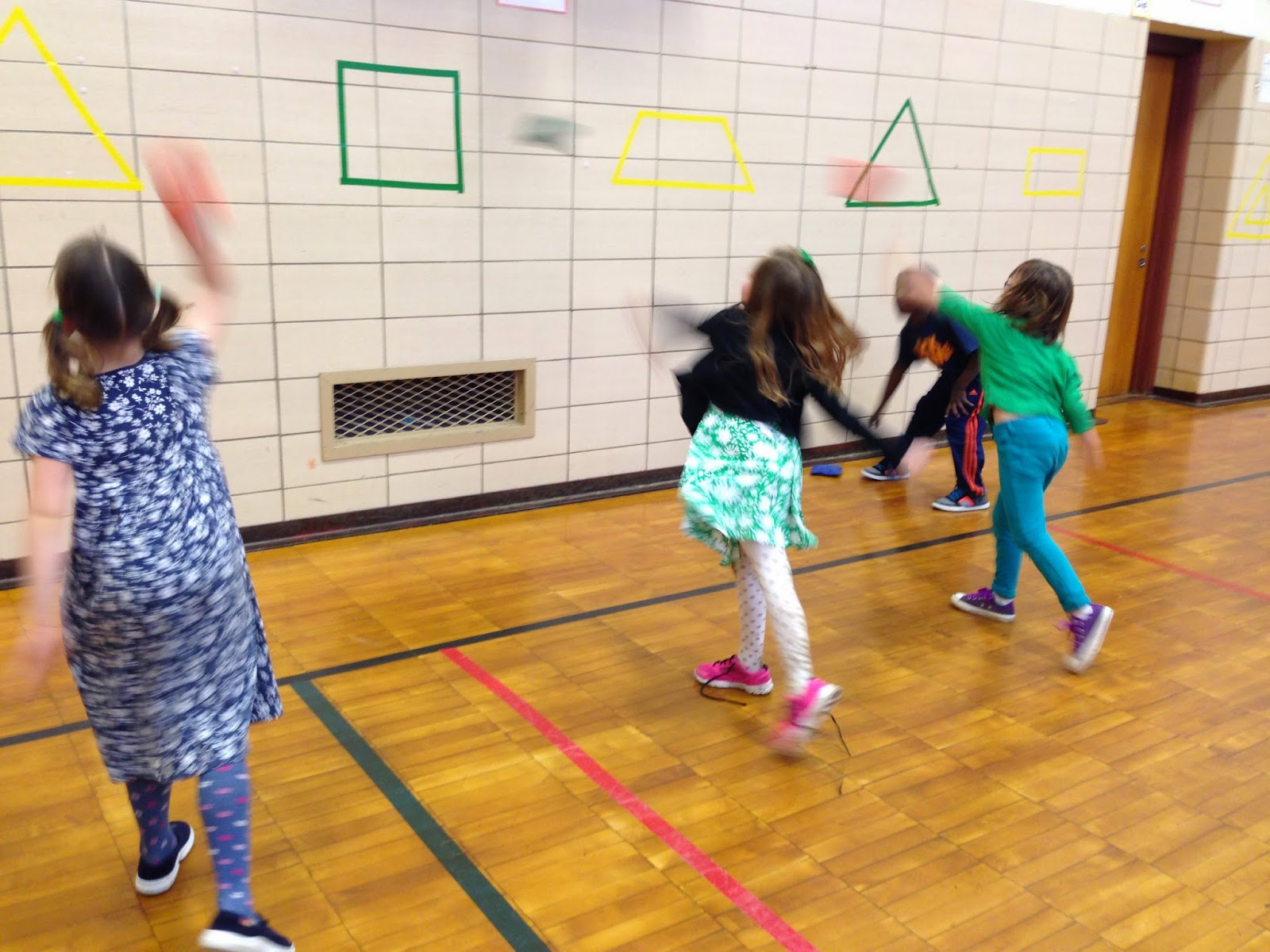
    Kindergarten, Young Fives, 1st, and 2nd graders completed a continuous jog cardiovascular warm-up and then stretch.  Next, students used paddles with beanbags.  This lesson (from Landy & Landy, Ready to Use PE Lessons for K-3, 1992, p 245) targets hand-eye coordination, visual tracking, and right-left dexterity.  Using a bean bag instead of a ball allows for more on-task time with these skills, since it eliminates the need to chase a bouncing ball around.

    Examples of verbal prompts I gave during the lesson, along with demonstrations:
    • Walk with your beanbag on the paddle.  Try different locomotor skills (skip, gallop, sideways slide-step, tiptoe walk, etc). 
    • Holding your beanbag on your paddle, try to sit down-stand up again without dropping.  How can you move the paddle all around your body, transfer it from hand to hand, high/low, right/left, front/behind? 
    • Can you toss your beanbag up in the air and catch it with your free hand?  Can you trap it between the paddle and your free hand?  Switch hands and try it again.  
    • Toss the beanbag up with your free hand and catch it on the paddle.  Try to toss it higher.  Switch hands. 
    • Toss the beanbag off of your paddle and catch it on your paddle.  Count how many times you can do it without dropping the beanbag.  Switch hands. 
    • Toss the beanbag holding the paddle palm up (forehand position), catch it with your palm down (backhand position).  Try switching hands.  Can you do other tricks?  
    • Stand facing your partner.  Put your beanbag on your paddle.  Toss and catch it with your partner using your paddle.  Try:  toss with paddle, catch with hand.  
    Kindergarteners exploring tossing and catching beanbags with paddles.  
    Partner toss/catch.  
    Grades 3-5 students, following their 10 minute continuous jog warm-up, will participate in the human knot activity.   Students are divided into groups of 4-10 students.  They stand in a circle.  They hold up their right hand and each take another group member's hand (not the person next to them, though).  Then, repeat with left hands - and it can't be the same person whose right hand you're holding.  Then, students move and try to untie the "human knot" they've created, returning to a circle formation.  This activity works on communication, strategy, teamwork, spatial awareness, and listening skills.  


    Friday, April 24, 2015

    PE: Y5 - 5

    In PE this week, students are participating in a 7 minute continuous jog warm up.  During this warm-up, a scoreboard is projected onto the wall with 7 minutes on the clock (pictured and described in last week's blog post).

    5th graders running.  The clock is projected onto the wall to let students know exactly how much time is left.  
    After our warm-up, classes participated in cooperative hoops during one PE class.  Students form a circle and join hands.  A hula hoop is placed on one student's arm.  The challenge is to move the hoop all the way around the circle and back to where it started without letting go of hands.  Students work on spatial awareness concepts, communication, teamwork, and cooperation during this activity.

    After warm-up during the second PE class of the week, students played a quick round of Pins and Baskets (2nd - 5th grades), Guard the Pin (1st grade), or Clean Out Your Backyard (K and Y5).  

    Self-contained ASD classes this week worked on kicking and throwing in PE classes, along with our regular routine cardiovascular/locomotor skill warm-up.  We also played t-ball, and even ventured outside for a walk around the sidewalk track!!

    Ms. Addison's POHI class continued with working on individual goals during PE.  These goals including walking with or without a gait trainer, throwing/rolling/catching a ball, grasping objects, and participating in a t-ball activity.

    Monday, March 30, 2015

    Parachute!!!!

    5th graders beginning the parachute lesson
    This week, Y5-5th graders will be enjoying parachute during PE classes!!  Parachute brings back many fond memories of my own elementary PE classes.

    Along with being a PE favorite, parachute also provides many opportunities to reinforce and continue working on motor skills and movement patterns.  The concepts listed below are from the AAPS PE Curriculum (Motor Skills and Movement Patterns strand, Movement Concepts domain), which is aligned with the Michigan GLCEs for PE.  Also included are specific examples of ways parachute can help with these concepts.

    • Space awareness:  Directions (up/down, forward/backward, right/left, clockwise/counterclockwise).  For example, we walk clockwise/counterclockwise while holding the parachute.  Students move the parachute up/down.  Students are asked to step forward/backward.  
    • Space awareness:  Levels (low, medium, high).  Example:  Students hold the parachute at a low level (at feet), medium level (waist), high level (above head).  
    • Effort:  Time (fast/slow, sudden/sustained).  Example:  Students shake the parachute fast or slow.  Students move the parachute suddenly or hold it in a sustained manner.  
    • Effort:  Force (strong/light).  Example:  Students move the parachute with different amounts of force during our activities.  
    • Relationships:  Relationship movement concepts of objects and/or people (over/under, on/off, in front/behind).  Example:  Students put their knees on top of the parachute to create a mushroom balloon with the parachute.  Students also put the parachute behind them to create an igloo.  


    Tuesday, March 17, 2015

    Overhand Throw and more

    This week, fifth graders are finishing up miscellaneous Fitness Testing items as needed.  

    Grades 3-4:

    • Jump Rope challenge warm-up.  Get a rope and go to letter seats and start jumping.  When the music starts, your challenge is to jump as much as you can during ONE song (about 3 minutes).  If you miss, reset yourself and keep jumping!  Take breaks with side-swings if needed, and then go back to jumping.  (During this time, I am usually also jumping with them - demonstrating some of the tricks we have learned and giving feedback as needed.)
    • First class of the week:  Game Day!  Many classes have earned a game day through being prepared for PE class.  
    • Second class:  Overhand throw activities.  Review steps of overhand throw (T, Muscle, Step, Throw), and concepts (stepping with opposite foot gives more force, eyes on your target, etc.).  Throwing practice.  
    Grades Y5-2: 
    • Locomotor skills warm-up. 
    • First class of the week:  Game Day!  Many of these classes have also earned game days by arriving to PE prepared.  
    • Second class:  Overhand throw.  Demonstrate the steps with the keywords of the overhand throw (T, Muscle, Step, Throw).  Practice at wall targets.  During this practice time, I circulate to students to give specific feedback.  We also take about 10 minutes of this class period and do some activities with the beanbags, and then conclude the class with a few more target throws.  
    First graders practicing the "Muscle!" step of throwing.
     "THROW!"

    Monday, March 9, 2015

    Jump, Jump!!

    This week's jump rope lessons will be in centers.

    Centers for younger students will be:
    1.  Basics and tricks with Mrs. Stoops (I give them a water break before we rotate from this center.)
    2.  Side swings - practicing swinging the rope side to side, with a figure 8 motion with both hands holding jump rope handles.
    3.  Free Jump
    4.  Shapes on the floor with your rope


    Older student centers will be:
    1.  Basics and tricks with Mrs. Stoops
    2.  Contest
    3.  Water break
    4.  Long ropes
    5.  Free Jump


    Since all students used beaded ropes (pictured below) last week, fourth and fifth grade students will choose between beaded and speed ropes for this week's centers (third graders will have a choice the second PE class of this week).  Beaded ropes are best for learning to jump rope because it provides more weight to the rope, making it easier to feel the rope as it swings around.  It also provides auditory feedback when the rope hits the floor.  Speed ropes are best for, well, speed, as they are lighter.  They're great for fast jumping, tricks that involve high rope speed, and cardiovascular training.

    These are actual jump ropes from Haisley, with "You Rock!" added with photo editing.  

    Tuesday, March 3, 2015

    New Warm-Up

    I recently observed a warm-up in another PE class and thought we would give it a try!  Here's a picture of fourth grade students participating here at Haisley.  I am introducing this warm-up to students this week.

    Gym setup:  Four cones near one endline, different colors.  A corresponding set of four cones (matching colors) near the other endline.  Students divide into approximately even groups, behind the cones at one end of the gym.

    Activity:  Students move, one at a time, to the other cone using the specified skill (run, skip, gallop, slide-step, high knees, back kicks, etc.).  Once they reach the other cone, they walk around the edges back to their group's start cone.  Students wait until the person before them reaches the half court line before starting.  It's not a race, and with built-in walking breaks, allows students to self-pace appropriately for their cardiovascular fitness level.

    We usually do warm-up activities for five minutes or less.  Often the length of one song is perfect, and the addition of music helps increase energy.  =)

    Monday, March 2, 2015

    Jump Rope!

    This week, students will be learning a new warm-up routine, and then starting a jump rope unit.  We begin with basics:  how to measure a jump rope and find the right length for you, basic jumps (single and double bounce jumps), and then go through some basic and advanced jump rope tricks for those who are ready.

    Earlier in the school year, K-2 students experienced some movement exploration lessons with jump ropes.  For those lessons, ropes were on the floor and not used for traditional rope jumping.  For these lessons, we are focusing on the skill of jumping over the rope in a rhythmic, consistent pattern.  Students who have mastered basic jumping skills will then work on more advanced jumping skills.

    Some of our jump rope tricks/skills include:


    • Straddles (side, front, double)
    • X
    • Rocker
    • Boxer
    • Skier
    • Bells
    • Skier-bell combo
    • Twister
    • Peek-a-boo
    • Heel to heel
    • Toe to toe
    • Heel-to-toe
    • Front leg kicks
    Jumping rope is an excellent cardiovascular fitness activity.  The Jump Rope Institute has some excellent resources related to jumping rope.  

    Monday, December 1, 2014

    Y5-5: Week of 12/1/2014

    Locomotor Go Fish:  This week, grades K-5 will be participating in an activity called Locomotor Go Fish (see previous blog post for activity specifics).  Students young and old enjoy this activity.  Students review locomotor skills (skip, hop, gallop, jump, run, walk) in a competitive activity.  The activity is a little like the card game Go Fish crossed with a relay race.

    Young Fives will participate in a variety of bean bag, hula hoop, and low organization games.  These will include Bean Bag Helper, Musical Hoops, and Clean Out Your Backyard.  These games review and reinforce following basic game rules, locomotor skills, space awareness, and throwing/rolling skills.

    Bean Bag Helper:  Each student balances a bean bag on their head.  They walk around the play area - without touching or holding onto their beanbag.  If their beanbag falls down, they are frozen.  Others who are not frozen can **carefully** bend down and pick up classmates' beanbags, place them in their hands, and then the frozen student is back in the game.

    Musical Hoops:  This game is like musical chairs.  When the music is on, they move around the play area using different locomotor skills.  When the music stops, they have to find a hoop.  Different from musical chairs, they can share space in the hoop when the music stops.  They're "in" the hoop if only one foot is inside the hoop.  I usually stop the game with two hoops left.

    Clean Out Your Backyard:  The gym is divided in half with cones.  The class is divided in half, and each team must stay on their half of the gym.  The foam balls are "trash", and nobody wants trash in the backyard!  In this game, they throw or roll the "trash" onto their neighbor's yard.  (I do mention that in real life, you should throw trash in trash cans!!)  Students are reminded of the elements of overhand throw/underhand roll/underhand throw.  No kicking or hitting the ball allowed.  Students encouraged to throw into open space.  Playing this game in young fives and kindergarten prepares students for Guard the Pin, the reward game day for grades 1-2.