Showing posts with label underhand throw. Show all posts

Monday, May 23, 2016

Week of 5/16: Sinkerball! Beanbag relays!

Grades 2-5:  
For this week in PE, grades 2-5 played a game called Sinkerball.  I found the game on a site called www.physedgames.com.  Here is the video description of the rules:  

Classes really enjoyed this game!  Classes played during both of their PE classes this week, with new teams each time.  This game works on throwing/rolling, and also strategy and teamwork.  We discuss how strategy is a plan to be successful - and how in this game, some strategies may include:

  • starting the game and staying away from the throwers as much as possible
  • protecting your pin with your body as much as possible while pulling it
  • if your pin is down, helping someone with fewer or no helpers protect their pin
  • tossing balls to the back or side of the playing area, rather than right back to the throwing team, if you are protecting a pin
  • coordinating with other throwers to throw many balls at once at one pin
Some adaptations from the video rules we used include: 
  • only throw/roll - no kicking, no hockey sticks
  • throw zone on one side of the gym worked best for our gym size
  • played for time (rather than points) - team with longest time with at least one pin standing won that round
Classes watched the video directions before dividing into teams and starting the game.  


Grades Y5-1: 
Younger classes worked on bean bag relays this week.  This activity helps younger students understand the concept of a relay activity - one person from your team leaves at a time, and the next person has to wait for them to return before leaving.  Beanbags were hidden under about 25 cones in the playing area.  Relay teams worked to retrieve one beanbag at a time, by looking under one cone per turn.

Friday, May 6, 2016

Week of 5/2 and 5/9: Fitness Testing & Centers

A kindergarten student made this for me.  :)  
Grades 3-5 Centers:
1.  Fitness Testing:  Flexed Arm Hang and Sit and Reach.  Students complete these tests with me, and then practice curl-ups on the mats.  For more information on Flexed Arm Hang and Sit and Reach testing, see my previous blog post (Sit and Reach) or the FitnessGram site.  
2.  Hula Hoops. 
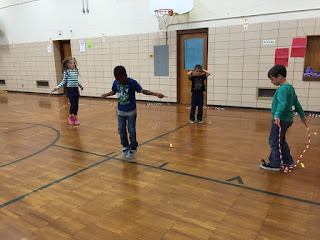
3.  Jump Ropes. 
4.  Exercises:  jumping jacks, burpees, stretches, ski jumps, scissor jumps, push ups, ABC strong solders -- students choose which exercises to do at this center.  These exercises also help warm students up for the sit and reach test, as muscles are more flexible when they are warmed up!

FitnessGram reports for grades 3-5 will come home the last day of school, along with student final report cards.

Grades 3-5:  Curl-ups!  See the FitnessGram site for information on this test. :)  

Grades Y5-2 Centers: 
1.  Jacks:  Underhand toss and catch the jack back and forth with a partner.  Count how many catches you have in a row without dropping the jack!  Start over if one partner drops it. 
2.  Hula Hoops.  One hoop per person, choose between a large hoop or small one!  Have a contest with group members, roll it with a partner, jump through the hoop like it's a jump rope, or just plain hula hoop with it!  
3.  Jump Ropes.  Practice jumping!  Start with the rope behind you, swing it over your head.  Use your eyes to look 
4.  Balance boards.  Take turns balancing on the center of the balance board.  When you're finished, go to the other board to wait your turn (one board is slightly higher off of the ground than the other board, so I have students try both).  When you are up next, count to ten slowly so the person balancing knows when their turn is up.

Young fives learning how to participate at the balance board center.


Pathways/directions/statues warm-up:  Young fives

Underhand throw/catch the jack center:  First graders

Hula!  

Jump Ropes

Balance boards in action:  First graders

Grades Y5-2:  Hula Hoops and Jump Rope!!  


Monday, December 1, 2014

Y5-5: Week of 12/1/2014

Locomotor Go Fish:  This week, grades K-5 will be participating in an activity called Locomotor Go Fish (see previous blog post for activity specifics).  Students young and old enjoy this activity.  Students review locomotor skills (skip, hop, gallop, jump, run, walk) in a competitive activity.  The activity is a little like the card game Go Fish crossed with a relay race.

Young Fives will participate in a variety of bean bag, hula hoop, and low organization games.  These will include Bean Bag Helper, Musical Hoops, and Clean Out Your Backyard.  These games review and reinforce following basic game rules, locomotor skills, space awareness, and throwing/rolling skills.

Bean Bag Helper:  Each student balances a bean bag on their head.  They walk around the play area - without touching or holding onto their beanbag.  If their beanbag falls down, they are frozen.  Others who are not frozen can **carefully** bend down and pick up classmates' beanbags, place them in their hands, and then the frozen student is back in the game.

Musical Hoops:  This game is like musical chairs.  When the music is on, they move around the play area using different locomotor skills.  When the music stops, they have to find a hoop.  Different from musical chairs, they can share space in the hoop when the music stops.  They're "in" the hoop if only one foot is inside the hoop.  I usually stop the game with two hoops left.

Clean Out Your Backyard:  The gym is divided in half with cones.  The class is divided in half, and each team must stay on their half of the gym.  The foam balls are "trash", and nobody wants trash in the backyard!  In this game, they throw or roll the "trash" onto their neighbor's yard.  (I do mention that in real life, you should throw trash in trash cans!!)  Students are reminded of the elements of overhand throw/underhand roll/underhand throw.  No kicking or hitting the ball allowed.  Students encouraged to throw into open space.  Playing this game in young fives and kindergarten prepares students for Guard the Pin, the reward game day for grades 1-2.


Monday, November 3, 2014

Being prepared: Incentive program grades 1-5

Grades 1-5 have an incentive program to be prepared for PE class.  If the entire class is prepared for PE class, the class earns a star.  To earn a star, everyone in the class must have on appropriate gym shoes (rubber sole, covered toe, covered heel), and all jewelry (dangling earrings/necklaces/bracelets/watches most commonly) removed when class begins.

Once the class earns four weeks of stars, they earn a game day!  The game day is scheduled as it works for our PE schedule.  Classes sometimes have to wait to have their game day happen - but we record when the game day actually happens, and they continue earning stars toward their next game day each class.

For grades 1-2, the reward game is Guard the Pin.  Grades 3-5, the reward game is Pins and Baskets.  Gym setup and many of the basic rules are the same for both:  the gym is divided in half with cones.  The class is divided evenly into two teams.  Players may not cross the center line of the gym.  The goal of the game is to knock over the other team's pins.  First team to knock over the other team's pins wins that round.  Each pin can have one pin guard, who must stay standing and may not touch the pin to stop it from falling or hold it up.  Players may only roll or throw the ball -- no kicking or hitting the ball.

For Pins and Baskets, if a team makes a green $$money ball$$ basket on the center hoop only (without crossing the center line), they can reset all of their team's pins.

Many ask:  isn't this just dodgeball?!?!?  No, it isn't.  We don't ever play dodgeball or games where humans are targets.  Students are aiming at the pins, and pin guards are only volunteers.  I explain to students that the best success I've had (and I've played this game A LOT) is with rolling the ball and knocking it against the back wall to hit the pins.  :)

Most students seem to love this game, and I enjoy participating with students when I can.  This game also works on overhand throwing, rolling, and space awareness.  For first graders, this is one of the first games we do following "Clean Out Your Backyard" (which they LOVE!!!).
A third grade class enjoys a game of Pins and Baskets

Thursday, January 10, 2013

K-2: Underhand Throw

Grades K-2 are working on the underhand throw.  We break the skill into three parts:

Important vocabulary for this skill includes:  opposite foot, release, and follow through.  These ideas are important and relevant to many fitness and sports activities, and resurface during many future lessons and activities.

I demonstrate the underhand throw several times, and have students watch my demonstration for different important points.  Students repeat the key words (Step, Swing, and Point) several times, and then practice the motion without the ball or bean bag.  Finally, they have practice time with the object at their own target.

For the first day of practice, the target is a rectangular brick along the outside edge of the gym.  Each student has their own target.  Students take three steps out from the wall, turn around, and underhand throw to their target.  I circulate checking for opposite foot and basic parts of the skill, giving feedback to each student during practice.

For the second day of this topic, centers are used for practice.  Students have a variety of high and low targets at each center.  Center descriptions are posted on the wall, and are described and demonstrated before students begin rotations.

Wall targets are created with tape.  They are different shapes: pentagon, hexagon, triangle, and rectangle. These labeled targets reinforce geometry and math concepts learned in the classroom.  

Bowling pins (3) are the target for this center. Students love to hear them clatter to the floor when they hit the target!  

Hula hoops on the floor are targets for this center.  
An additional fitness or activity center is also used for this lesson, and may include jump rope, hula hoops, balance boards, or balance beam.  During this centers activity, I choose one center and give focused feedback to each student during their time at that one center.