Showing posts with label paddles. Show all posts

Tuesday, February 2, 2016

Week of 1/25/2016

Health: First Grade
In health this week, we learned about how germs spread, how we can prevent germs from spreading, and the importance of washing our hands.

PE:  SXI and ASD
Our SXI classroom continued to enjoy Tball, and worked on locomotor/manipulative skills individually selected based on student interest and skill level!  Our ASD classrooms practiced locomotor skills during our warm up, improve flexibility during stretches, game skills and kicking during kickball, and making active choices during choice time.

PE:  Young Fives, 1st, and 2nd Grades
Lower elementary students participated in an interval warm-up, and then reviewing the steps to the overhand throw (T, Muscle, Step, Throw).  Next, students reviewed the rules of the game "Clean Out Your Backyard" (Young fives and K) or "Guard the Pin" (1st and 2nd grades).  These games use the overhand throw, so students have practice using their skills in a dynamic setting.

Mrs. Strohl's class 


PE:  3rd through 5th Grades
After an interval warmup, upper elementary students continued work with paddles, learning the game of Pickleball!  Pickleball is very similar to tennis, but played with a short wooden paddle and a small wiffle ball.  In past weeks, we have learned how to strike the ball using the paddle, and this week, we are enjoyed a game with that skill.  Students had a brief introduction to basic, modified Pickleball rules, and then we played King/Queen of the court style.  One side of the court is the King or Queen.  The other side is the challenger.  If the challenger loses the point, they go to the back of the line and the next challenger tries to win a point.  If a challenger wins the point, they take the Queen/King's spot and the Queen/King goes to the end of the challenger line.  It's a fast moving way to have students enjoy using our nets and paddles safely, and allowing many chances to have contact with the ball.  Students of all ability levels enjoyed this game, and the friendly competition was quite exciting!

Fifth grade Pickleball setup.  King/Queen of the courts are on the right side.  Challengers are on the left.  
5th grade Kings/Queens =)
4th graders play Pickleball King/Queen of the court
Third graders
Third graders
Third graders
Third and fourth graders:  Ms. Hahn's class.
Fifth graders
Bam!  5th graders enjoying pickleball.
Mr. Carnegie's class

Friday, January 22, 2016

Week of 1/19/2016

Young Fives through 5th grade PE:  This week, all classes are starting with a new warm up:  intervals!  We use the projector to put an interval timer on the gym wall, and then follow along with different exercises.  20 seconds of exercise, 10 seconds of rest.  Grades 2-5 did burpees/jumping jacks or lunges/high knees for their exercises, and young fives, kindergarten, and first graders did jumping jacks and running in place for their exercises.  Before beginning, we review each exercise, and I demonstrate the correct form, along with adaptations students can use if they need to go at a lower intensity (for example, stepping legs out and in during burpees rather than jumping).  Students practice, and then we do just under four minutes of intervals.  After drinks, we moved on to continue work with our paddles.

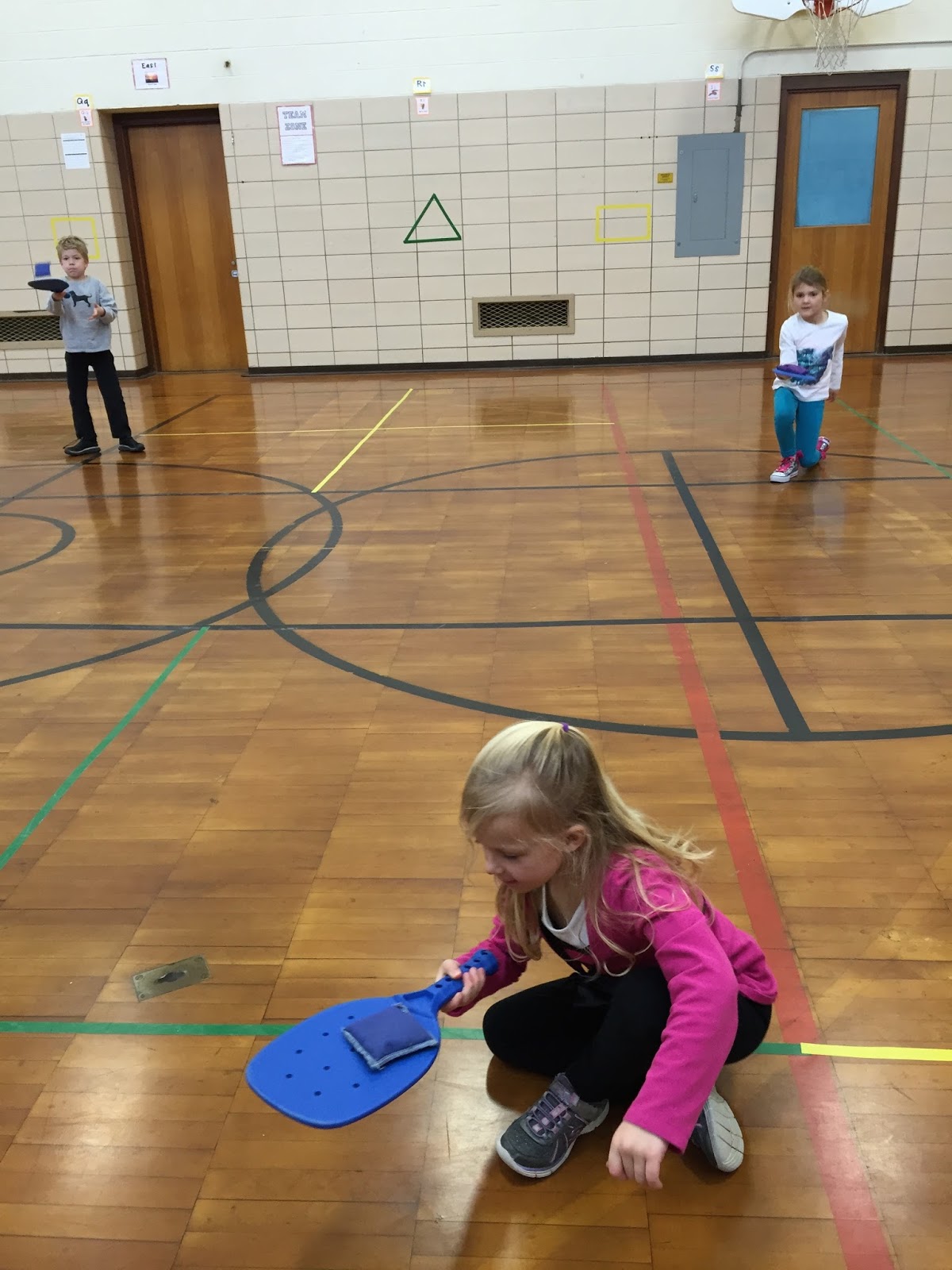
Young fives, kindergarten, first and second graders worked with paddles and beanbags.  Each student had their own paddle and bean bag.  We call the bean bags Beanie, and the paddles Patty.  Students learn how to hold the paddle with a handshake grip.  Then, students are encouraged to try:
  • balancing their bean bag on their paddle
  • toss the bean bag up, catch it on Patty
  • try to balance Beanie, holding Patty, and sit down all the way to the floor - without touching Beanie or the floor- and stand back up again without dropping Beanie!
  • toss it from Patty, catch it in your free hand
  • walk balancing Beanie on Patty, gallop, skip, sideways slidestep
  • how many times can you toss Beanie up from Patty and catch it without dropping it?  
Third, fourth, and fifth graders continued working with paddles and foam balls.  Each student shared a court space with a partner and took turns hitting forehand/backhand shots at the wall.  Handshake grip, keeping paddle perpendicular to the floor, swing parallel to the floor, and trying to maintain a rally is emphasized.  

A student is hitting the ball at her court's wall.  Her partner waits for his turn behind the court area.  
Fifth graders.  Each taped "T" on the floor is one court.  We previously used the taped lines for two square or four square.  
Fourth graders.  
Fourth graders.  The center cones mark the waiting spot for partners.  The center area of the gym is also referred to as "the sidewalk".  Students use this area to move to another court if their ball rolls away from them (rather than walking through classmates' playing areas!).  
This kindergartener balances Beanie on Patty.  
Toss!  
First graders sitting down while balancing Beanie, then try to stand up while keeping Beanie balanced on Patty.  
Balancing!  
Sitting down - while balancing Beanie.  
Moving around the gym while balancing Beanie.   We walked, galloped, skipped, and sideways slide-stepped. 
Third graders use wall space to practice forehand strokes.
Moving around the gym while balancing.  

PE-Humanities/Health:  In health classes this week, students watched a personal safety video and then discussed how to stay safer from bad touch. 

ASD:  ASD classrooms continue to follow our routine, using a visual schedule:  locomotor skill warm-up, stretches, a game (TBall or Kickball), and then choice time.   
Visual schedule for ASD classes.  We check the schedule after we complete each item, and either move it to the right strip of velcro, or add a matching image next to the item to show we finished that section of class.  
SXI:  The SXI class has continued to enjoy taking turns at TBall and then moving, moving, moving!  We do individual activities with students based on their interests and levels.  Some may work on visually tracking objects, others may work on throwing and catching a ball, while others may be taking as many steps as possible during our time in the gym.  

Friday, January 15, 2016

Week of 1/11/16

Lower Elementary:  Parachute!  
Lower elementary students are having their turn with the parachute this week!  And, needless to say, they are LOVING the parachute.  We start with introductory concepts (where to stand, how to hold the parachute safely, etc.), then practice how to inflate the parachute without it.  Then, it's time for the fun!  We shake the parachute - slow/fast, high/low.  We inflate it - making a big bubble up above our heads.  Depending on the grade level, we do different things - we might inflate it several more times, do color switching activities (under/around the parachute), shake the parachute with foam balls on top (popcorn), and go under the parachute after inflating (igloo).

Although the parachute is clearly AMAZINGLY AWESOME, we are working on many important concepts while we are having fun.  Movement concepts for lower elementary students during parachute include:

  • sudden/sustained movements
  • moving in unison = all together at the same time
  • strong/light movements (use a large amount of force or a small amount)
  • high/low, start/stop, slow/fast, big/small
  • up/down, on/off, above/below
Many of these concepts are relationship-based, so they are hard to measure -- but certainly very important in daily life and in other subjects!!


Kindergarten enjoying the parachute!  


Young Fives
Upper Elementary:  Paddles
Upper elementary students are working with paddles.  For their first lesson this week, they use their hands as paddles.  They start with a ball at individual wall spaces.  Tasks include:
  • hit the ball with one hand and catching it, then hit with the other hand
  • try to continuously hit the ball against the wall at your wall space - see how many you can do without losing control of the ball
  • try to hit the ball against the wall with one hand, then the other hand - alternating this way - see how many you can do without losing control
  • try to hit the ball and hit the target 
Then, we gather near the dry erase board and go over rules for two square: 
  • play starts with a bounce-serve
  • ball must go over the center line
  • one bounce only allowed
  • after you hit it, the ball must bounce inside your opponent's square
  • keep score: 
    • one point scored if: 
      • ball bounces twice
      • ball lands out of bounds
Then we divide into pairs and play begins!  Time permitting, groups combine into groups of four and begin playing four square.  One fifth grade class asked to play four square indoors with playground balls, so for the last five minutes of class, we tried it.  


Fifth graders play two square with hand paddles


Fifth graders: four square

Four square with a playground ball

Fourth graders playing two square


For their second lesson, they use an actual paddle to strike the ball.  We have two types of paddles:  wood and plastic.  They are short, about 15" from the end of the handle to the tip of the paddle.  We use them in a variety of ways to improve eye-hand coordination, and also for striking skills.  Students are encouraged to try some or all of the following tasks:

  • balance the ball on top of the paddle - knuckles up (forehand), fingers up (backhand)
  • bounce the ball lightly up from the paddle (forehand and backhand trip)
  • bounce the ball to the floor from the paddle


ASD and SXI Classrooms
In ASD PE classes, we have added two stretches to our routine.  The stretches happen after our warm up, which includes laps around the gym.  We do laps that include walking, running, galloping, skipping, and sideways slide-stepping.  Adding stretching to our routine helps with flexibility, and also helps prepare students for middle school PE, where stretching is often a part of every class.

SXI continues to enjoy playing t-ball, and working on activities and skills based on each individual student.  These activities and skills may include tracking an object with eyes, holding/pushing/pulling a ball or object, throwing an object, throwing at a target, or catching.

1st grade PE/Humanities - Health:  Medicines, Poisons & Tobacco
In health classes this week, first graders learned about staying safe from medicines and poisons.  We learned some rules:
Medicine:  

  • only take medicine from a trusted adult
  • never share medicine with another child
  • never take more than a trusted adult says to take or gives you
Poisons:  
If you're not sure what something is, never sniff, swallow, taste, or play with it!  

We also learned about how smoking and tobacco use can damage our bodies, making our hearts work harder, and hurting our lungs and mouths.  Students learned what secondhand smoke is, and ways that they, as first graders can avoid secondhand smoke.  Ideas included: 
  • move away from the person smoking
  • go to another room
  • go outside
  • open a window
  • keep bedroom door shut if someone in the house smokes
  • respectfully ask the person to stop smoking
Family resource sheets were also sent home for these topics, as well as our Personal Safety unit.  We'll be learning about how to stay personally safe next week!  

Thursday, April 30, 2015

PE: Week of 4/27

This week in PE, we continued to add time to our cardiovascular warm-up.   Most classes completed a 10 minute continuous jog in the gym.  We've been gradually increasing our movement time to prepare for the mile and half mile run tests.  As the weather continues to improve, I'll be taking classes outside to complete their half mile/mile run test.  Please send students with layers for warmth, particularly if they have PE early in the morning.

Kindergarten, Young Fives, 1st, and 2nd graders completed a continuous jog cardiovascular warm-up and then stretch.  Next, students used paddles with beanbags.  This lesson (from Landy & Landy, Ready to Use PE Lessons for K-3, 1992, p 245) targets hand-eye coordination, visual tracking, and right-left dexterity.  Using a bean bag instead of a ball allows for more on-task time with these skills, since it eliminates the need to chase a bouncing ball around.

Examples of verbal prompts I gave during the lesson, along with demonstrations:
  • Walk with your beanbag on the paddle.  Try different locomotor skills (skip, gallop, sideways slide-step, tiptoe walk, etc). 
  • Holding your beanbag on your paddle, try to sit down-stand up again without dropping.  How can you move the paddle all around your body, transfer it from hand to hand, high/low, right/left, front/behind? 
  • Can you toss your beanbag up in the air and catch it with your free hand?  Can you trap it between the paddle and your free hand?  Switch hands and try it again.  
  • Toss the beanbag up with your free hand and catch it on the paddle.  Try to toss it higher.  Switch hands. 
  • Toss the beanbag off of your paddle and catch it on your paddle.  Count how many times you can do it without dropping the beanbag.  Switch hands. 
  • Toss the beanbag holding the paddle palm up (forehand position), catch it with your palm down (backhand position).  Try switching hands.  Can you do other tricks?  
  • Stand facing your partner.  Put your beanbag on your paddle.  Toss and catch it with your partner using your paddle.  Try:  toss with paddle, catch with hand.  
Kindergarteners exploring tossing and catching beanbags with paddles.  
Partner toss/catch.  
Grades 3-5 students, following their 10 minute continuous jog warm-up, will participate in the human knot activity.   Students are divided into groups of 4-10 students.  They stand in a circle.  They hold up their right hand and each take another group member's hand (not the person next to them, though).  Then, repeat with left hands - and it can't be the same person whose right hand you're holding.  Then, students move and try to untie the "human knot" they've created, returning to a circle formation.  This activity works on communication, strategy, teamwork, spatial awareness, and listening skills.