Showing posts with label cardiovascular fitness. Show all posts

Friday, April 22, 2016

Week of 4/18 & 4/24: Mile Run, cardiovascular fitness, and more!!

Grades 3-5:  This week, we begin our spring round of the Mile Run test and AMAP (see below for information).  For grades 3-5, "The Mile" is part of our FitnessGram testing.  Any student grades 3-5 not finishing or not participating in the mile test during regularly schedule PE class will either make the test up during another PE class or during lunch recess (fifth graders makeups are almost always during recess because of scheduling).  Students are encouraged to take a speedwalk break as needed, to be safe, pace themselves, and try their very best during this activity.  Almost ALL students are physically able to do the mile in less than 20 minutes, even if walking the whole way.  We can do it!! This year, I added music -- bringing the wireless speaker and iPod outside.  This makes the atmosphere more fun for students!  Additionally, I run a stopwatch app on my phone during the test, and set this on the rolling cart.  This way, students can be checking their times at each lap.  (See photo below of the stopwatch!)

I truly strive to make The Mile fun and focus on best effort, intentionally NOT making the test a high pressure, anxiety-producing experience for students.  Just like everything at school, each student approaches the mile run differently, with a different fitness level, amount of sleep the night before, different breakfast/lunch/food before the test, emotional status, effort level, etc.  I only ask that students give their best effort when we test!  

For more information about Fitness Testing, check out my other blog posts about this topic, including this one from last spring:  http://haisleyphysicaleducation.blogspot.com/2015/05/pe-weeks-of-54-and-511.html

All grades -- AMAP:  AMAP stands for As Many As Possible.  I found this idea on a PE blog, and have used it this week!  Classes compete to see who can get the most laps per student.  Students hold a piece of paper and get a mark each time they go around.  I total these laps and divide by the number of class participants, and that's the magic number (laps per student)!!  Kindergarten and young fives have not participated in this yet -- but will in the next few weeks.  

For some classes, we used the mile run bubble sheets for AMAP.  For other classes, we used scrap paper (no names needed since total laps are divided by the total number of runners!).  

Grade 2:  Second graders experience a practice of the mile run test during PE in the spring.  This helps students know what the mile run test looks, feels, and sounds like -- before third grade.  I tell second grade students if they don't finish a mile during our time, it's okay - just try your best, and this is a practice!  Second graders are also participating in AMAP.  =)  

Grade 1:  First graders do a half mile timed test, and also AMAP.  During our AMAP time, many students have completed more than one mile!!  

Grade Y5 and K:  Young Fives and kindergarteners experienced "Sidewalk Track 101".  We talk about how the sidewalk track is the area around the "big kid" playground.  The sidewalk track is used for our school Walk-a-Thon, and for mile testing starting in third grade (and spring second graders).  We discuss basic expectations before going outside:  keep moving, hands/body to yourself, stay on the sidewalk, and listen for the whistle/megaphone for directions.  Then we take a walk around the sidewalk track all together.  We stop at different points around the track to talk about expectations.  Then, students are allowed to do 1-2 laps (time permitting) around the track at their own pace (speedwalking/jogging/running).  Y5 and K will do AMAP in the coming weeks.  

"Bubble Sheets".  This student completed the fall mile in 7 minutes 27 seconds.  WOW!  This time, he beat his old time, completing the mile in 7 minutes 13 seconds.  I share with students that my mile pace is between 9 and 12 minutes per mile when running 3+ miles.  I need to get out and complete my own mile run test!!  

These are the outside expectations, and Half/Mile Test talking points we review before each test.  

This is the stopwatch app to show students their time during the test.  


Friday, January 22, 2016

Week of 1/19/2016

Young Fives through 5th grade PE:  This week, all classes are starting with a new warm up:  intervals!  We use the projector to put an interval timer on the gym wall, and then follow along with different exercises.  20 seconds of exercise, 10 seconds of rest.  Grades 2-5 did burpees/jumping jacks or lunges/high knees for their exercises, and young fives, kindergarten, and first graders did jumping jacks and running in place for their exercises.  Before beginning, we review each exercise, and I demonstrate the correct form, along with adaptations students can use if they need to go at a lower intensity (for example, stepping legs out and in during burpees rather than jumping).  Students practice, and then we do just under four minutes of intervals.  After drinks, we moved on to continue work with our paddles.

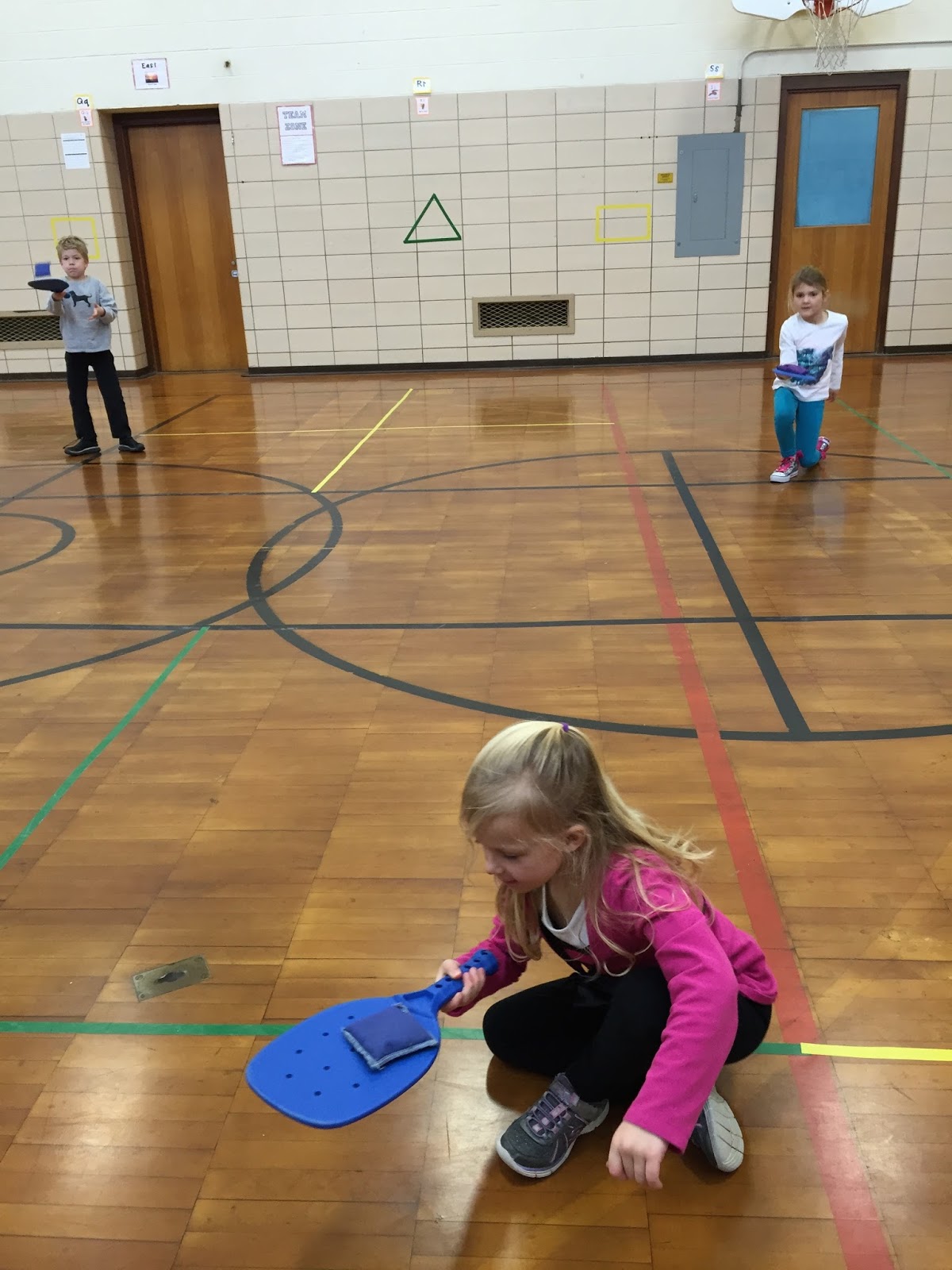
Young fives, kindergarten, first and second graders worked with paddles and beanbags.  Each student had their own paddle and bean bag.  We call the bean bags Beanie, and the paddles Patty.  Students learn how to hold the paddle with a handshake grip.  Then, students are encouraged to try:
  • balancing their bean bag on their paddle
  • toss the bean bag up, catch it on Patty
  • try to balance Beanie, holding Patty, and sit down all the way to the floor - without touching Beanie or the floor- and stand back up again without dropping Beanie!
  • toss it from Patty, catch it in your free hand
  • walk balancing Beanie on Patty, gallop, skip, sideways slidestep
  • how many times can you toss Beanie up from Patty and catch it without dropping it?  
Third, fourth, and fifth graders continued working with paddles and foam balls.  Each student shared a court space with a partner and took turns hitting forehand/backhand shots at the wall.  Handshake grip, keeping paddle perpendicular to the floor, swing parallel to the floor, and trying to maintain a rally is emphasized.  

A student is hitting the ball at her court's wall.  Her partner waits for his turn behind the court area.  
Fifth graders.  Each taped "T" on the floor is one court.  We previously used the taped lines for two square or four square.  
Fourth graders.  
Fourth graders.  The center cones mark the waiting spot for partners.  The center area of the gym is also referred to as "the sidewalk".  Students use this area to move to another court if their ball rolls away from them (rather than walking through classmates' playing areas!).  
This kindergartener balances Beanie on Patty.  
Toss!  
First graders sitting down while balancing Beanie, then try to stand up while keeping Beanie balanced on Patty.  
Balancing!  
Sitting down - while balancing Beanie.  
Moving around the gym while balancing Beanie.   We walked, galloped, skipped, and sideways slide-stepped. 
Third graders use wall space to practice forehand strokes.
Moving around the gym while balancing.  

PE-Humanities/Health:  In health classes this week, students watched a personal safety video and then discussed how to stay safer from bad touch. 

ASD:  ASD classrooms continue to follow our routine, using a visual schedule:  locomotor skill warm-up, stretches, a game (TBall or Kickball), and then choice time.   
Visual schedule for ASD classes.  We check the schedule after we complete each item, and either move it to the right strip of velcro, or add a matching image next to the item to show we finished that section of class.  
SXI:  The SXI class has continued to enjoy taking turns at TBall and then moving, moving, moving!  We do individual activities with students based on their interests and levels.  Some may work on visually tracking objects, others may work on throwing and catching a ball, while others may be taking as many steps as possible during our time in the gym.  

Thursday, December 17, 2015

Week of 12/14

Y5-2:  Students will work on the overhand throw!  We work on four steps for throwing:

  • T:  point to target, body shaped like a T, opposite hand pointing at target
  • Muscle:  Bend arm with ball/beanbag up, showing your muscle
  • Step:  Step with opposite foot, transferring weight from back to front
  • Throw:  Let the ball/beanbag go, end pointing toward target
During our first class of the week, students are assessed before instruction on the overhand throw.  Then, we do instruction on the keywords -- with teacher demonstration, student practice without a beanbag, and then practice at individual mid-level targets with a beanbag.  I circulate during this practice time and give students feedback on their form.  I have them say the keywords while they're moving their bodies for each step of throwing.  This is to help them remember each step.  

Students then practice with a low target (a foam cylinder shaped pin).  Then we move to partners (throwing at two pins, trying to knock both down at once), and then larger groups as time permits.  


3rd-4th, and Carnegie (5th):  These classes experienced basketball dribbling last week, so they are moving on to do basic jump rope activities.  These activities are adapted from Landy and Landy, Ready to Use PE Activities for Grades 3-4.  Activities include: 
  • Rope patterns: stretch rope along the floor for these activities  (speed jump rope)
    • jump zig zag from one end to the other end, facing forward, sideways
    • hop back and forth across your rope, move from end to end
    • straddle your rope, and jump this way (one foot each side of the rope)
    • jump straddle-cross, so your rope is between your feet each jump.  
    • keep hands on the floor while you jump your feet back and forth, while you move along the rope.  
    • what are other ways you can move on or over your rope?  
  • Circle patterns:  (speed jump rope)
    • make your rope into a circle
    • make a tall statue inside your circle
    • make yourself as small as you can, as big as you can
    • make a bridge with X parts inside the circle, X parts outside the circle (tried several of these!)
    • put your hand in the center of the circle, legs straight out.  Walk legs around your hand like a grinder (coffee grinder),  switching hands and directions after two times around. 
    • leave your circle and do different locomotor patterns to the music.  When the music stops, find an open circle and listen for directions (make a statue, bridge, balance, do an exercise, etc.).  
    • Shapes:  For these next activities, students switched to a beaded jump rope.  
      • make a shape with your rope -- any shape - circle, triangle, rectangle, hexagon, pentagon, parallelogram, etc.  
      • make letters and or numbers with your rope
      • with a partner (or small group), make some new shapes.  you now have twice the rope to work with!  
  • For our second lesson of the week, grades 3 and 4 start out with a brainstorm of shapes they could make with jump ropes.  Some ideas include:  a house, igloo, sailboat, sunshine, clouds, flower, name(s) in cursive, letters, numbers, words, Nike logo, Under Armor logo, mitten, New Hampshire (!!  a second grade student did this last week, unprompted!), any state....and more. :)  
5th graders enjoying our jump rope lesson
5th grade rope shapes

Michigan!   


5th graders:  GO BLUE!   
Fourth graders at work


4th graders transfer the Scream painting (below) to our gym floor

Fourth graders:  ice cream cone!
3rd and 4th graders make cupcakes!

Weindorf/Schafer:  Basketball dribbling activities, or fitness testing as needed!  See previous posts for upper elementary basketball/fitness testing activities. 


First grade health:  This week, we learned how and why to call 911.  Then, we started a craftivity (craft + activity!) to review fire safety.  This craftivity will take several weeks to complete, and we'll send home the final products in January.   


SXI:  The SXI class continues to work on t-ball, bowling, and moving, moving, moving during our PE time.  We adapt tasks as needed to allow for maximum participation and success.  For example, we have a ramp to use for bowling.  Each student has different needs and abilities, and we aim to have all students having fun, moving, and learning!  

ASD:  Both ASD classes have similar PE routines.  Students walk around cones in the gym, and then participate in a locomotor skill warm-up (gallop, skip, sideways slide-step, and run).  During some classes, we practice throwing/kicking/catching.  Next, we play kickball or t-ball, followed by choice time.  We have a large therapy ball they enjoy, scooters, hula hoops, playground balls are some options during choice time.  In January, students will add some stretching activities following our locomotor skill warm-up.  These activities work on following directions, cardiovascular fitness, flexibility, listening skills, taking turns, and basic locomotor/manipulative skills.  Basic locomotor and manipulative skills serve as the basis for all sports and activities.